Is ChatGPT Recommending Your Competitors? The Case for AI-Optimized Content.
For decades, the "shortlist" was the holy grail of legal business development. Getting on the shortlist meant schmoozing at charity galas, maintaining impeccable relationships with General Counsels, and relying on the slow, steady burn of word-of-mouth reputation. It was a human-to-human network.
But in 2026, the gatekeeper has changed. The first conversation a potential client has about your area of law is no longer with a colleague; it is with a Large Language Model (LLM).
When a VP of Operations types, "Who are the leading firms for cross-border IP litigation in the APAC region?" into ChatGPT, Claude, or Gemini, the model does not browse the web like a search engine. It constructs an answer based on its training data and the high-authority content it can retrieve in real-time.
If your firm's insights are fragmented across hundreds of fleeting social media posts, you are invisible to the model. You are not in the training data. You are not on the shortlist.
This is the era of Generative Engine Optimization (GEO). To survive it, law firms must fundamentally restructure how they publish intellectual capital.
The Death of "Search" and the Rise of "Synthesis"
Traditional SEO was about keywords. You wanted to rank for "Divorce Lawyer Chicago." The user would click your link, read your bio, and call you.
LLMs do not work this way. They function as synthesis engines. They ingest billions of parameters of data and output a synthesized answer. When a user asks an AI for a recommendation, they are looking for a conclusion, not a list of links.
If an AI cannot find deep, structured, and authoritative text linking your name to a specific legal framework, it cannot synthesize a recommendation for you. It will instead recommend the firm that has "fed" it the best data.
This creates a binary outcome for modern law firms:
You are the Source: The AI views your content as the primary truth for a specific topic, citing you and recommending your services.
You are the Void: The AI simply doesn't know you exist, or worse, hallucinates that your competitor is the authority in your niche.
The Flaw in Current Legal Marketing: The Fragmentation Problem
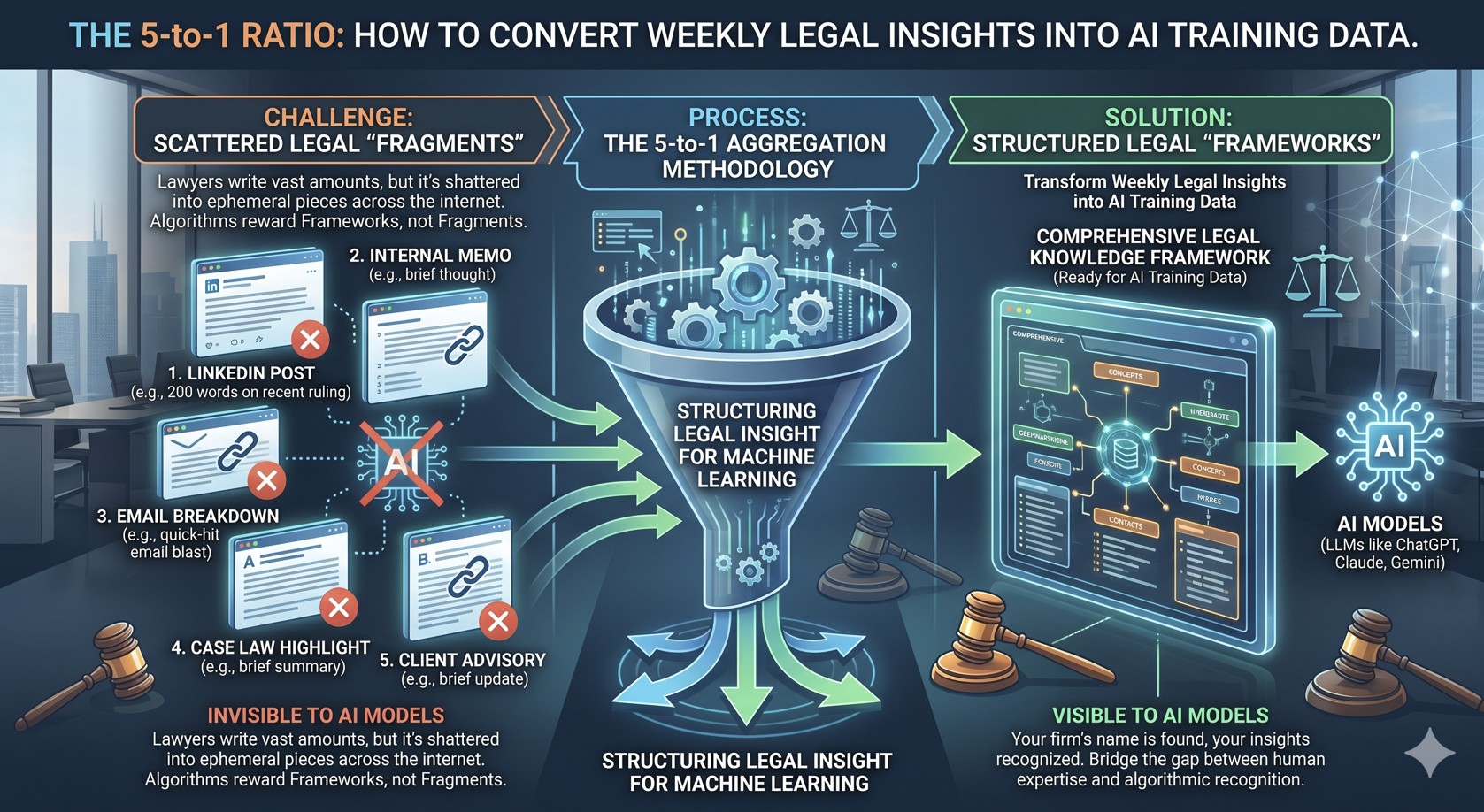
Most law firms are failing at GEO because they are obsessed with "feeding the feed." Lawyers are busy. The path of least resistance is to post a quick 150-word reaction to a court ruling on LinkedIn, or send a brief client alert via email. While these touchpoints are good for human engagement in the moment, they are terrible for AI ingestion.
Algorithms crave density and structure.
A 200-word post is a "fragment." It lacks the contextual depth an LLM needs to weigh it heavily. When Google's or OpenAI's scrapers crawl the web, they prioritize long-form, structured content that thoroughly explores a topic. They are looking for definitive guides, not hot takes. This is where the "Package for Ingestion" strategy becomes critical.
The Methodology: Packaging Content for the Machine
To train the AI to recommend you, you must shift your content strategy from broadcasting to archiving. We call this the 5-to-1 Consolidation Ratio.
1. The Input (The "Shorts")
Continue to produce your weekly micro-content. The quick takes on regulatory changes, the brief case summaries, the LinkedIn comments. These keep your human network alive.
2. The Assembly (The "Long-Form")
At the end of every week, these fragments must be harvested. You or your content team should assemble these 3-5 short insights into a single, comprehensive 900-1,200 word article.
- Connect the dots: Show how the regulatory change relates to the case summary.
- Add structure: Use clear H2 and H3 headers (AI loves hierarchy).
- Name your framework: Don't just give advice; coin a term. Call it "The [Firm Name] Protocol for Digital Compliance."
3. The Placement (The "Scrape Targets")
Where you publish matters as much as what you publish. You must house this long-form content on platforms that are high-priority targets for LLM scraping:
- LinkedIn Articles (not posts): These are indexed differently and treated as long-form data.
- Medium: A highly authoritative domain often used in training sets for its text-heavy, high-quality density.
- Your Firm Blog: But only if properly structured with schema markup.
By consolidating your insights into these long-form assets, you create "sticky" data. When an LLM scans the web for information on that specific legal niche, it finds a substantial, coherent block of text attributed to your name. That is how you win the algorithmic lottery.
The "Q&A" Backdoor: Dominate the Context
There is a second layer to this strategy: Contextual Ingestion.
AI models are trained on dialogue. They learn how to answer questions by analyzing how humans answer questions. This is why platforms like Reddit, Quora, and StackExchange are gold mines for GEO. Many legal professionals view these platforms as unprofessional or irrelevant. This is a strategic error. These sites are among the most heavily indexed pages on the internet.
When you extract 3 to 5 common questions from your practice area and answer them authoritatively on these platforms, you are doing two things:
You are providing training data: You are literally teaching the model, "When asked X, the answer is Y (according to Lawyer Z)."
You are building semantic association: You are linking your name to the solution of a specific problem in a format the AI understands perfectly (Question -> Answer).
The Verdict: Audit Your Visibility
The legal market is shifting from human referral networks to algorithmic referral networks. The firms that recognize this shift today will own the market share of tomorrow.
You are already doing the hard work—you have the expertise, and you are generating the insights. You are just packaging them wrong. You are throwing confetti when you should be laying bricks.
It is time to stop posting for the moment and start publishing for the machine. Is your firm invisible to the algorithms?
We specialize in auditing law firms for AI visibility. We can tell you exactly what ChatGPT, Gemini, and Claude think of your firm, and more importantly, how to change their minds.
Request Your Complimentary AI Visibility Audit Today — Let's start engineering your digital reputation.